

This post was originally published on the Cleanview newsletter, which I also write.
Next week, we’re publishing The Geography of Compute, a report about where companies are building data centers in the US. Today’s story is an excerpt from that report. If you’re interested in receiving the full report, reach out to learn more about Cleanview’s research subscription. If you’re a journalist, contact us here to get an early copy.
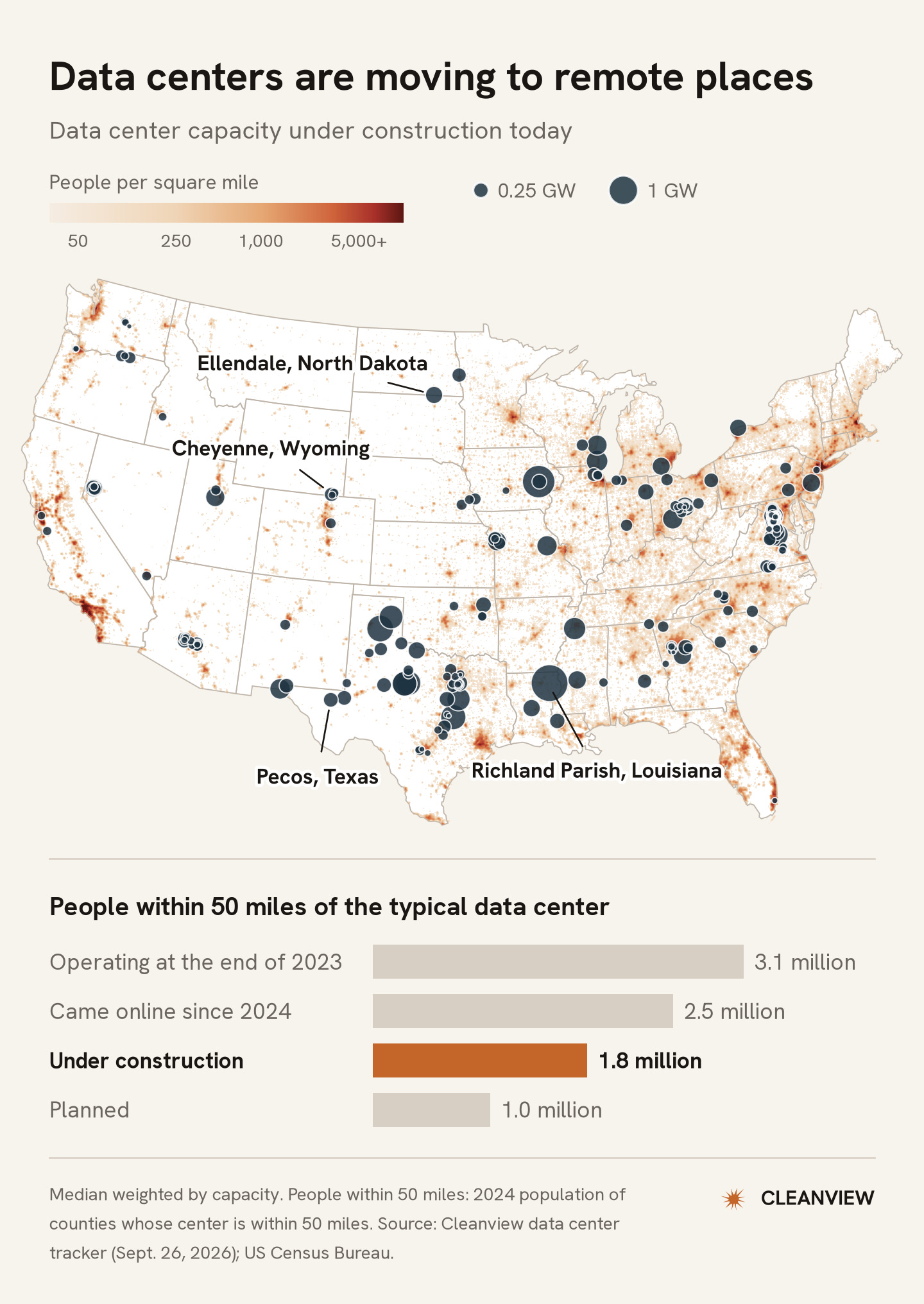
In remote and rural places across America, tech companies are pouring hundreds of billions of dollars into some of the most expensive infrastructure projects in the world. Most Americans have likely never heard of the communities soaking up this investment—places like Ellendale, North Dakota; Pecos, Texas; and Richland Parish, Louisiana. Nearly all of these places have one thing in common: They are located in states that voted for Trump.
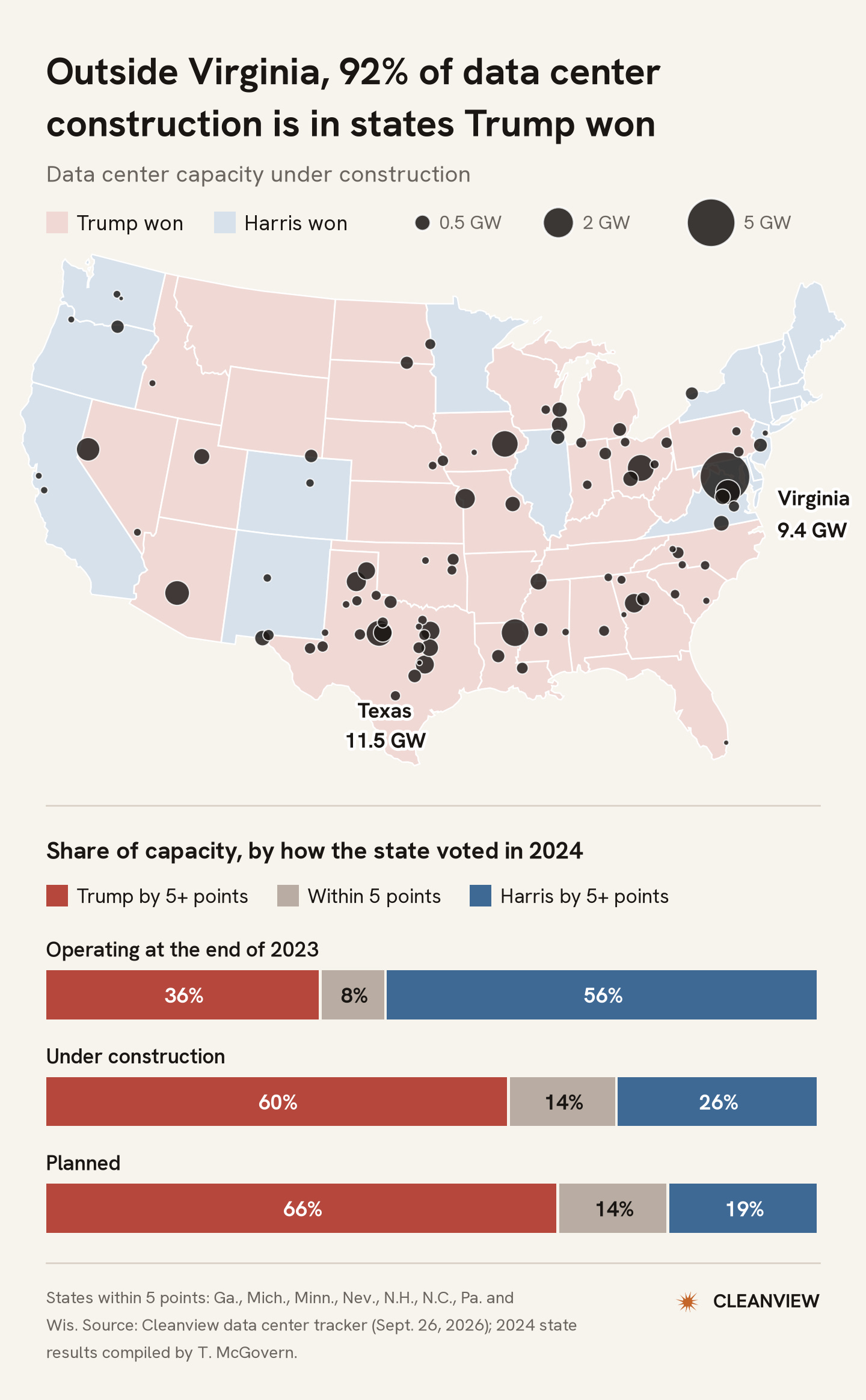
Before the launch of ChatGPT, most data centers were built in blue states. At that time, 56% of data center capacity was located in states that Kamala Harris won by 5 points or more. Just 36% of capacity was in states that Trump won by 5 points or more. (The remainder was built in swing states.)
Since then, the trend has flipped: 60% of data center capacity under construction is in states Trump won by 5 points or more. If you exclude Virginia, the picture is even more stark: 92% of data center construction is in states that Trump won.
So why are data center developers choosing to build in red states? One reason is permitting speed. Red states are more permissive when it comes to approving large-scale infrastructure projects of all kinds. Mississippi, for example, passed a bill in 2024 that allowed utilities to build gas plants for data centers without any public or regulatory review, as we wrote about in our last newsletter. By comparison, Oregon has banned new gas plants and offers more opportunity for public input.
Another factor is the price of electricity. Red states like Texas, Ohio, and Louisiana have lower power prices than most blue states. Electricity is the largest operating cost for a data center. We found that states with below-median industrial electricity prices have 62% of the capacity currently under construction.
But the most important reason is population density. Data center developers are increasingly seeking sites in remote places like West Texas. These places tend to be conservative.
Before the generative AI era, data centers were built near population centers. That’s because most of them served internet activities that required low latency, like video calls and Netflix videos.
Today’s data centers don’t need to be sited as close to people. Many of the largest data centers are dedicated to AI training, which can be done in remote places.
We plotted data center construction sites over a map of America’s population density, and the results were striking. At the end of 2023, the typical data center had 3.1 million people living within 50 miles of it. Today, the typical data center under construction has 1.8 million people living within 50 miles. Looking ahead, we found that planned projects that aren’t yet under construction would have 1 million people living within 50 miles.
These trends could change, however. Few political issues in the US have risen in salience faster than data centers. The issue isn’t as neatly partisan as topics like climate change. Politicians from Sen. Bernie Sanders to Texas Gov. Greg Abbott have voiced opposition to data centers and advocated for policies that would slow development. President Trump has been one of the biggest advocates for data centers, but many in his party have broken ranks.
Technology changes could shift where data centers are built too. As demand for inference—the process of serving large language models to users—grows, data center developers may try to site projects closer to population centers because serving users benefits from being nearby.
Crusoe, the developer most famous for its role in OpenAI’s Stargate initiative, is building some of the largest data centers in the world, located in remote parts of Texas. The company recently announced that it had raised $3.9 billion to build small, modular data centers that could be sited closer to people.
If development were to move back to dense areas, hyperscalers and AI labs would find themselves pitching a new political constituency: blue states and cities led by Democrats.
Get the full report
These are just a few of the takeaways from our upcoming report, The Geography of Compute. If you’re interested in receiving the full report, reach out to learn more about Cleanview’s research subscription. If you’re a journalist, contact us here to get an early copy.


