

I'm doing research right now on data center developers building their own power plants and this data shocked me: 48 GW of proposed data centers—roughly 33% of all planned capacity—now plan to skip the grid by building "behind-the-meter" projects.
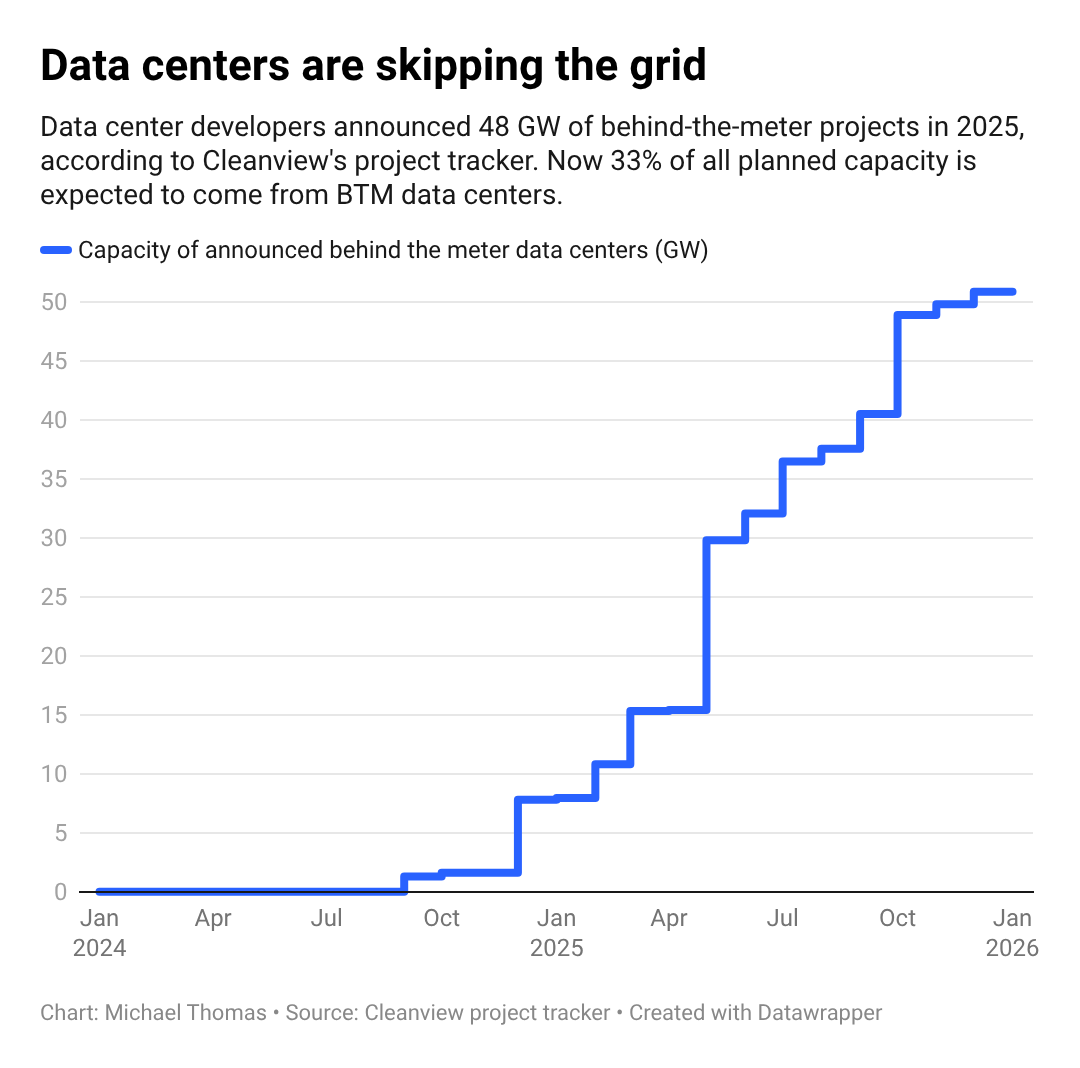
This is a very new trend. A little more than a year ago, virtually all data center developers planned to use the electric grid to power 100% of their projects. There were a lot of advantages to this—mainly the fact that you didn’t need to go into the power plant business if you wanted to stick some computer chips in a warehouse. You could just pay a utility a couple cents per kilowatt hour to run your operation.
In December 2024, there was less than 2 GW of planned behind-the-meter data center capacity, according to our data center tracker at Cleanview. By the end of 2025, developers had announced roughly 40 projects that planned to skip the grid partially or entirely with a combined 48 GW of capacity.
All of these projects are motivated by the same goal: getting their data center online as soon as possible.
It can take as long as 7 years to connect a hyperscale data center to the grid in a place like Virginia now. Building your own behind-the-meter power plant in a red state with lax regulations can get that time down to less than 2 years.
Some of these projects will soon be home to America's largest fossil fuel power plants, like Homer City Energy Campus in PA—a proposed 4.5 GW natural gas plant that will send all of its power to an onsite data center. The project has already been permitted and secured its gas turbines. It expects to start delivering power by 2027.
Other projects will use a combination of technologies—everything from solar, wind, batteries, and even nuclear. Natural gas is by far the most common, though. 72% of projects plan to use it.
But speed comes with a cost. Homer City's 4.5 GW project could soon become one of the largest single sources of carbon emissions in the country, emitting millions of tons of CO2 each year.
At Cleanview we're tracking more than 30 projects that plan to use onsite gas with a combined 48 GW of capacity. Virtually all of those projects were announced in just the last 12 months.
Other trends and stories I’m following
On the potential for an AI power glut
Earlier this month, Tracy Alloway of the excellent Odd Lots podcast wrote in her newsletter:
In a new report, CreditSights analysts led by Andy DeVries crunch the numbers to show that US utilities already appear to be in the process of building twice as much power capacity as is currently forecast to be needed by 2030. In other words, the data center buildout already looks to be outstripping demand for compute.
On the demand side: Using third-party estimates for future power demand from data centers (including estimates from BloombergNEF), the analysts come up with 94 gigawatts (GW) needed by 2030 and 138 GW by 2035. Subtracting the power that’s already in use today, leaves you with demand that’s expected to grow by a net 59 GW and 103 GW, respectively.
On the supply side: The analysts compile data center grid connection requests as reported by the actual companies doing the hookups, which are the utilities. Utilities generally report both firm commitments and more speculative pipeline projects, but CreditSights is only using actual committed projects here (which would make, if anything, the estimate of supply quite conservative). These connection requests are adjusted by a Power Usage Effectiveness factor to try to isolate the compute portion from other power needs like cooling, lighting etc. Put it altogether and you get 112 GW of firm supply capacity already lined up (even without counting that much larger supply of projects that might be in the pipeline).
It’s worth noting that the supply figures here are in addition to the “behind-the-meter” projects I wrote about above.
As I’ve written often on this newsletter, forecasting is difficult. There’s huge uncertainty around the demand for AI, its future efficiency, and the ability of any of these sluggish utilities to actually build these power plants. But history definitely suggests that some degree of overbuilding is a likely outcome. How much exactly is the trillion dollar question.
Mark Carney’s speech heard around the world
In his Davos speech last week, Canadian Prime Minister, Mark Carney did what few other powerful people have done in the last year: He stood up to Donald Trump and challenged his power. The full speech is worth watching due to its significance. But I’ll also say it was just a well-written, almost poetic, speech.
Carney’s speech, and this excerpt in particular, actually inspired me to write my post about the killings and injustices in Minneapolis:
In 1978, the Czech dissident Václav Havel, later president, wrote an essay called The Power of the Powerless, and in it, he asked a simple question: how did the communist system sustain itself?
And his answer began with a greengrocer.
Every morning, this shopkeeper places a sign in his window: ‘Workers of the world unite’. He doesn’t believe it, no-one does, but he places a sign anyway to avoid trouble, to signal compliance, to get along. And because every shopkeeper on every street does the same, the system persist – not through violence alone, but through the participation of ordinary people in rituals they privately know to be false.
Havel called this “living within a lie”.
The system’s power comes not from its truth, but from everyone’s willingness to perform as if it were true, and its fragility comes from the same source. When even one person stops performing, when the greengrocer removes his sign, the illusion begins to crack.
Friends, it is time for companies and countries to take their signs down.
Trump’s gift to China
Trump’s chaotic and aggressive trade policy was initially seen as a threat to Chinese manufacturing and exports. But now, it appears that it could have been a great gift as US allies strike deals with the country.
Earlier this month, Canada’s government announced a trade deal with China to import its cheap electric vehicles. Per the BBC:
The deal will see Canada ease tariffs on Chinese electric vehicles that it imposed in tandem with the US in 2024. In exchange, China will lower retaliatory tariffs on key Canadian agricultural products.
With the lower EV tariffs, approximately 10% of Canada’s electric vehicle sales are now expected to go to Chinese automakers, said Vivek Astvansh, a business professor at McGill University in Montreal.
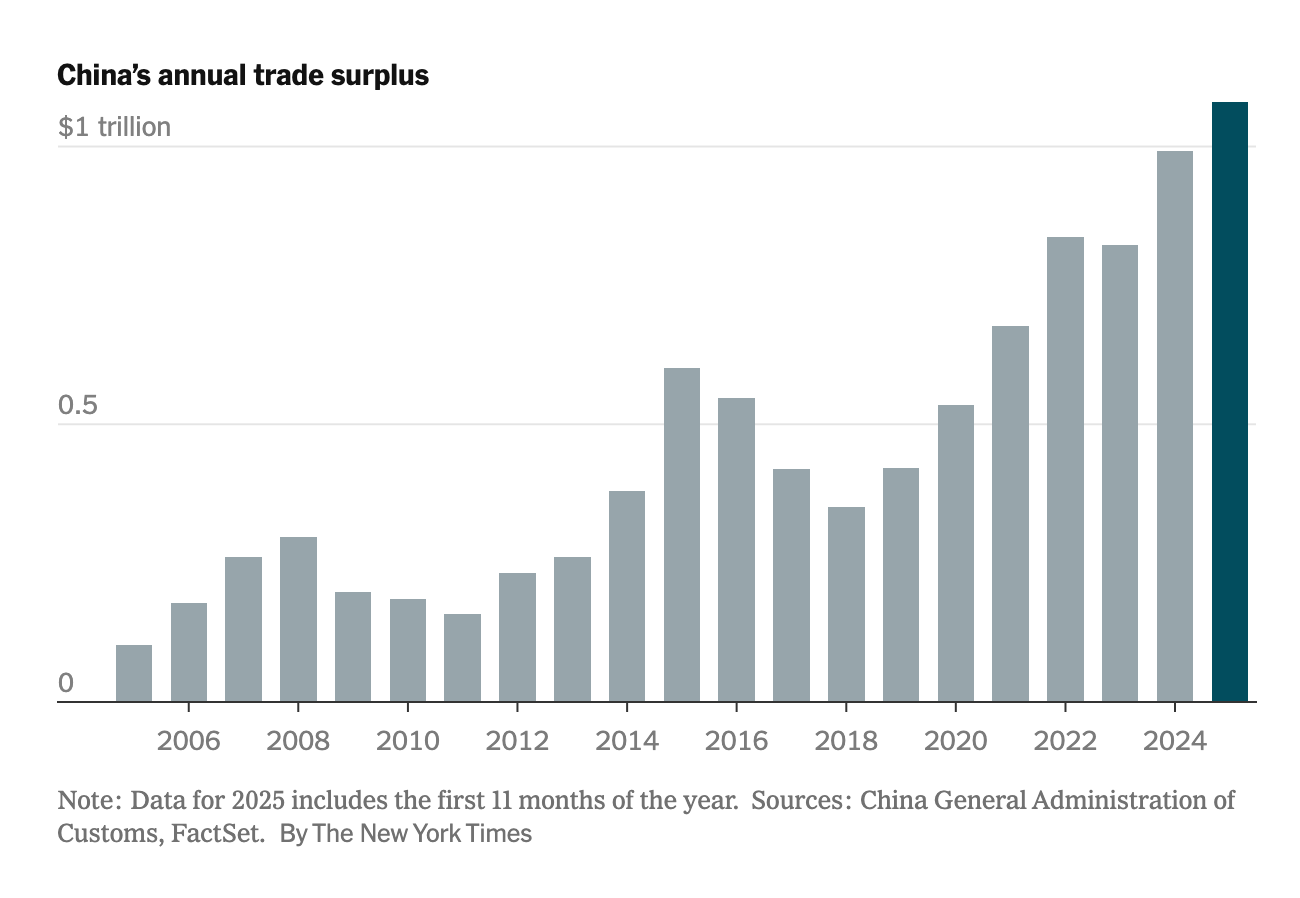
Canada isn’t the only country cutting deals with China or absorbing it’s overcapacity. China’s trade surplus rose in 2025, even as exports to the US fell. As the New York Times reports:
China’s surplus, the value of goods and services it sold abroad versus its imports, reached $1.19 trillion, an increase of 20 percent from 2024… For December alone, China’s surplus reached $114.14 billion, propelled by surging exports to the European Union, Africa, Latin America and Southeast Asia.
A few shows that have brought me joy recently
Over the last few years, I’ve come to love Cleo Abram’s YouTube series: Huge If True. Cleo’s optimism and curiosity are infectious. The visuals are beautiful. And the topics are often about scientific breakthroughs or research I had never heard of.
More recently—as in within just the last few days as I’ve been sick with the flu—I stumbled upon the YouTube show Track Star, which had a moment in 2025. On the show, host Jack Coyne gives famous musicians a pair of headphones, plays a song, and asks them to name the artist.
As the New Yorker’s David Remnick said in an interview, “It’s a sophisticated trick.” Coyne does a lot of research before every episode so he often plays songs of significance to the interviewee. “He’s making you tell a little bit about yourself and your life and your obsessions and your pleasures, maybe your heartbreaks. It is, in this ugly world, a relief and a pleasure to see people talking about what makes them feel something very deeply.”
This show with Jon Batiste brought me a lot of joy:
I used to work in off-grid solar in Africa and 8 years on I am seeing the same trend play out - a desire to beat the grid build-out with speed, even if it costs more (but it often costs less).
I wrote about data centres going off grid last year (link below) but didn't have good data on how many American systems were trying it (my piece focused on the UK where it's quite nascent). Will go have an explore on Cleanview to see what the latest is!
https://open.substack.com/pub/esgstuff/p/running-out-of-power-should-data