

Few companies in the world are hungrier for electricity than Google. In 2024, Google’s data centers used 30.8 million megawatt-hours of electricity—more than entire countries, and roughly double what they consumed just four years earlier. In the AI era, the company’s appetite for energy is only growing.
In the eyes of Google’s executives, AI is both a once-in-a-generation opportunity and an existential threat to its search monopoly. The company is spending accordingly: Alphabet invested roughly $90 billion in capital expenditures in 2025 and plans to nearly double that to as much as $185 billion in 2026.
Most of that money will flow to data centers—and the infrastructure needed to power them.
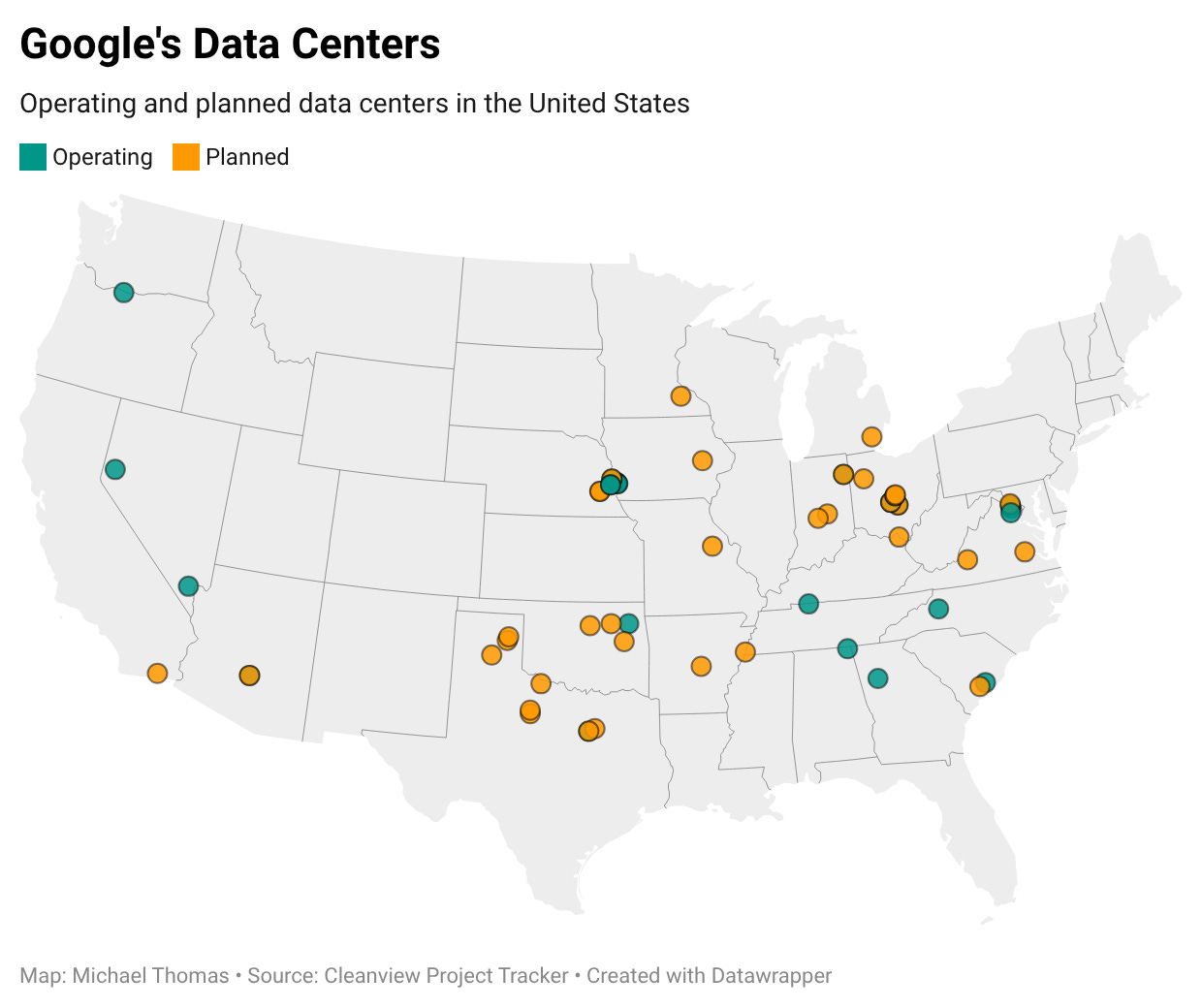
Each new data center requires as much electricity as a small city. Permit documents and site plans we obtained show campus designs that use 800–1,000 MW of power. And Google is building dozens of them. Cleanview now tracks 63 Google data center projects across 20 U.S. states. Finding enough electricity to power all of this development has become arguably the company’s most important operational challenge.
Until recently, Google’s power strategy was straightforward. The company worked with utilities to secure grid connections and then contracted with clean energy developers to match its electricity consumption. Google has spent more than a decade building a reputation as a climate leader on the strength of that model. It was the first major tech company to match 100% of its electricity consumption with renewable energy purchases. It pioneered the concept of 24/7 carbon-free energy. And it has signed more than 22 GW of clean energy power purchase agreements.
But our latest report—and the documents we obtained to produce it—reveal a more complicated story and an evolving power strategy.
In November 2025, Google announced its plans to invest $40 billion in Texas data centers. The company said that investment would fund new data center campuses in Armstrong County and Haskell County. In Armstrong County, Google confirmed to Cleanview that it has partnered with Crusoe Energy to develop a campus known as ‘Goodnight,’ near the town of Claude.
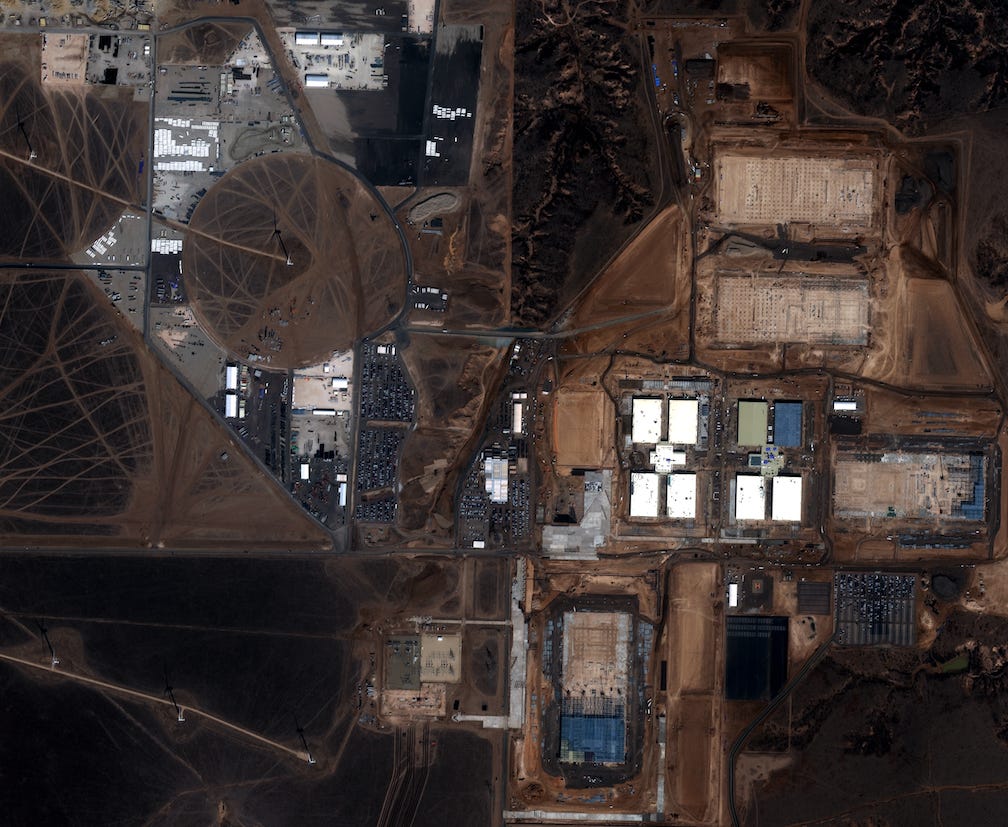
In January 2026, Crusoe filed a permit to build a 933 MW natural gas power plant onsite at the Goodnight campus. Documents obtained by Cleanview show that the gas plant would power two buildings on the campus and would not connect to the power grid. The gas turbines could emit as much as 4.5 million tons of CO2 per year. Cleanview commissioned high-resolution satellite imagery and confirmed the two buildings that would receive power from the gas plant are under construction.
When we reached out for comment, Google confirmed it has partnered with Crusoe to build the Goodnight campus. A Google spokesperson said the company hasn’t signed an offtake agreement with Crusoe for the natural gas plant. Someone familiar with the partnership between the two companies described the negotiations as ongoing and said the amount of power Google would use from the gas plant is still to be determined.
The Goodnight power plant is notable not just for its scale, but for what it lacks. In 2025, Google announced a first-of-its kind agreement to buy power from a 400 MW natural gas plant with carbon capture and storage (CCS) in Illinois. Documents obtained by the Flatwater Free Press suggest Google is exploring a proposed 1,000-3,000 MW gas plant with CCS in Nebraska. (Google told Cleanview they haven’t signed a contract for the project). Unlike these projects, Goodnight’s natural gas plant has no carbon capture technology.
To power its data centers, Google is also investing more in clean energy technology than almost any other entity—public or private—in the world. Since early 2025, the company has signed several gigawatts of new solar and wind PPAs across PJM, ERCOT, SPP, and MISO. It is paying $3 billion to keep aging hydroelectric dams on the grid in Pennsylvania. It is restarting Iowa’s only nuclear plant under a 25-year PPA. And it has signed first-of-their-kind offtake agreements for enhanced geothermal, 100-hour iron-air batteries, advanced nuclear fission, and even fusion energy.
Google is also finding innovative ways to use co-located renewables to connect its data centers in as little as 18 months. In February we published a report on Google’s partnership with AES in Texas, where it will co-locate a 850 MW data center with 600 MW of solar and 945 MW of wind and bypass the crowded ERCOT large-load queue in the process. In this report, we found another example of the strategy that hasn’t been reported on—this time with its soon-to-be subsidiary Intersect Power. Across these projects, Google is bringing nearly 2 GW of data center load online in 2027–2028, powered by co-located wind and solar, without entering the large load queue at all.
Our report shows that Google has pivoted from a grid+renewables strategy to what can be described as an “Everything Everywhere All at Once” strategy when it comes to powering its AI models and compute—one that includes everything from solar and wind to natural gas power.
Get the full report and dataset
The complete ~50-page report includes our analysis of 63 Google data centers across 20 states, detailed case studies, and the company’s evolving power strategy in the AI era. You’ll also get two data files—one covering all 63 data center sites and another with approximately 25 power deals and partnerships we identified.
Get the free excerpt
We’re releasing a free excerpt focused on one of the report’s most significant findings: The role of natural gas in Google’s data center strategy. You can read the excerpt here.
I can NEVER trust ai. It was created to deceive us for profits.