

The AI race has officially entered its Mad Max phase.
Over the last month, I reviewed hundreds of documents and satellite images for Cleanview’s latest report on behind-the-meter data centers. Meta’s data center strategy—which you can see from space—was one of the weirder approaches I came across.
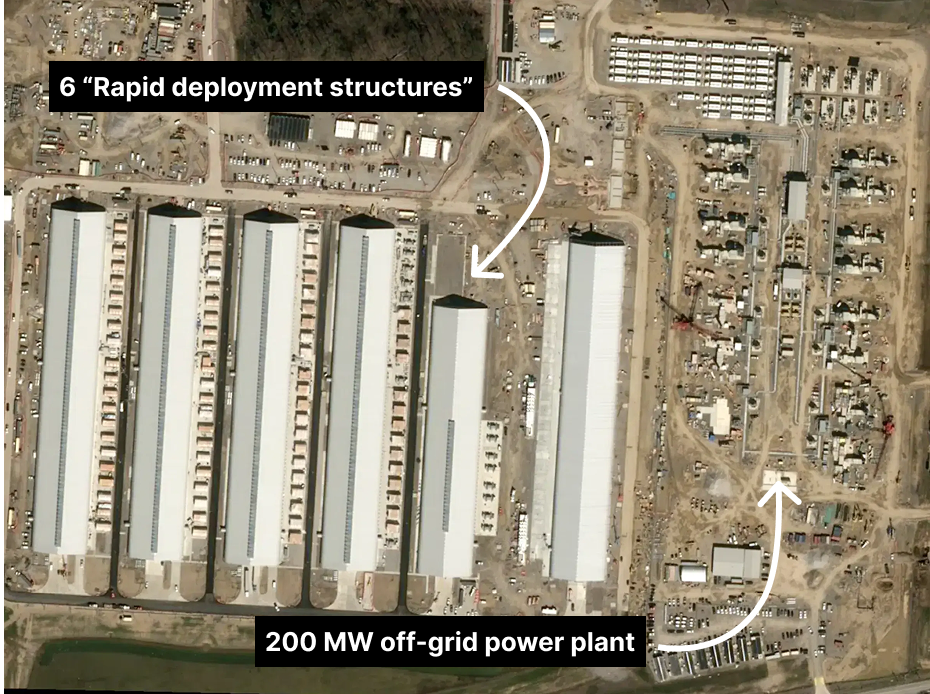
Mark Zuckerberg recently ditched the data center designs that Meta had perfected over the last decade and told his team to stick tens of thousands of chips in tents outside their data center in New Albany, Ohio. Each of these chips costs about $60,000. Zuckerberg plans to stick billions of dollars worth of them in the tents.
The strategy has helped cut the time to build compute in half. The first five buildings at Meta’s New Albany, Ohio data center took between two and three years to build. Meta started building five ~125,000 square foot tents between April and June of 2026, according to city permits. Satellite images show the structures have all been built.
To power those “rapid deployment structures”, as they are officially named, Meta signed a 10-year deal with Williams to build a pair of 200 MW off-grid power plants. Those power plants began construction about a year ago and are nearly complete.
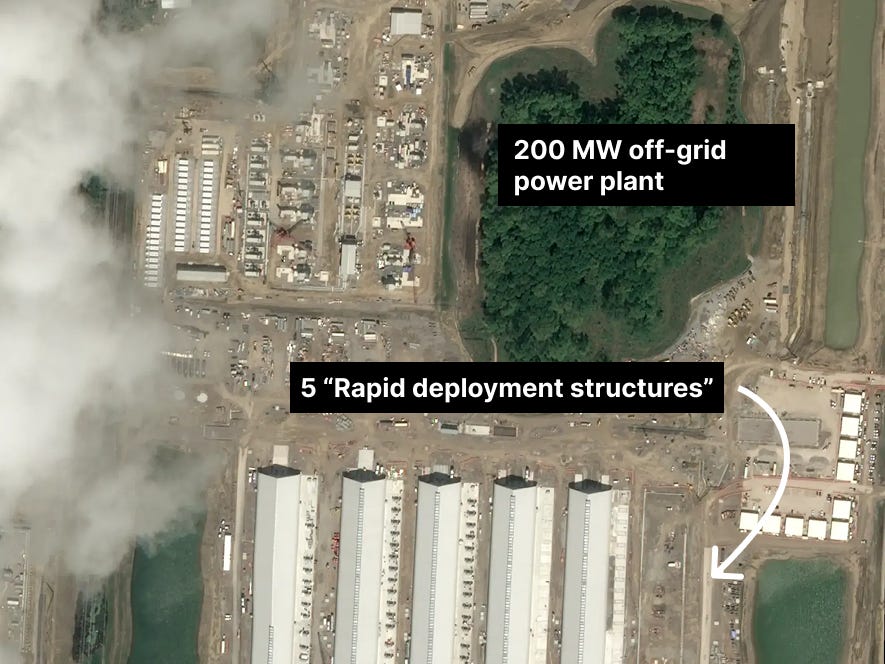
Meta is using the same strategy to build a data center in Tennessee, bringing the total count of tent data centers to three.
Strategies like this are part of the reason behind-the-meter data center capacity is growing so quickly. In Cleanview’s report, I found that there’s currently about 2 GW of BTM capacity online today. By the end of the year, it will likely be 3 GW—equivalent to three nuclear power plants. By the end of 2027, it could be as high as 13 GW—more than the power demand of NYC.
I’ve been talking to a lot of reporters about this research. When I told one reporter about these tents and other companies powering their data centers with jet engines, he said, “It’s like a scene out of the movie Mad Max.”
Read the full report
The full report mentioned above includes analysis of 59 behind-the-meter data center projects and the equipment powering them, detailed case studies of 15 projects with satellite imagery analysis, OEM market share breakdowns, and project timelines. It also includes the full dataset of projects and equipment.
You can read the full report on Cleanview’s website. We’ve released both a free summary and a ~75-page paid version with a dataset of all the projects. We also have a discounted option for nonprofits and researchers.