

Data centers need enormous amounts of electricity. But in many of the places they’re being built, locals are stopping new power projects from getting approved. That was one of my main takeaways from the research I did on clean energy project cancellations over the last month, which I shared earlier this week.
Virginia—home to the world’s largest data center market—has lost 6.7 GW of potential capacity due to power project cancellations this year, according to the analysis. Much of it was due to local opposition and bans on clean energy.
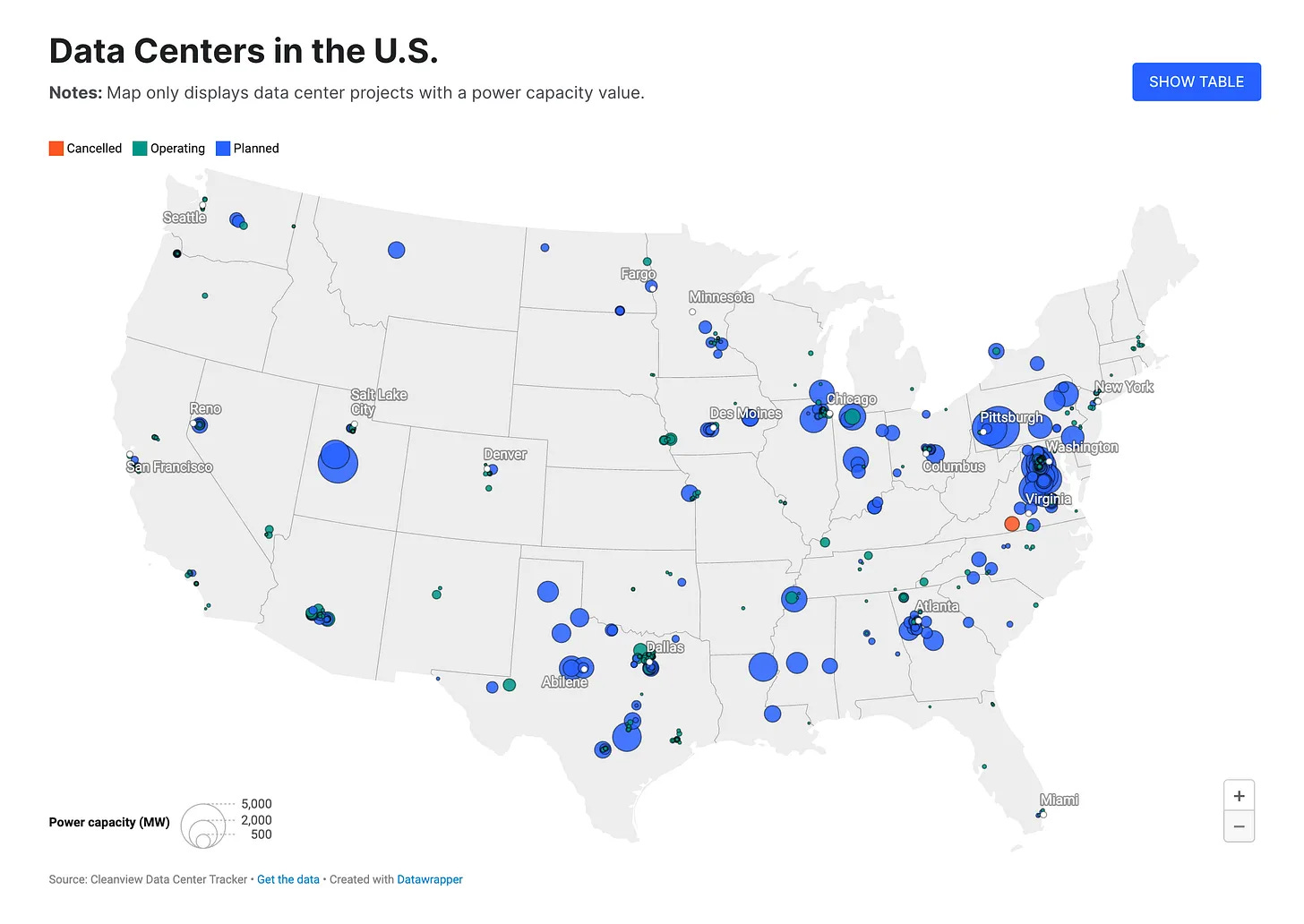
In the state, more solar permits are now denied than are approved. Recently Hanover County officials approved a 2.4 GW data center on the same night they denied a 20 MW solar project.
At least 10 Virginia counties have enacted outright bans or severe restrictions on solar, with Mecklenburg County—the state’s ninth-largest county—passing an ordinance in April 2025 that removed utility-scale solar as an allowed land use entirely.
The same dynamic is playing out across the US.
Officials in states like Ohio and Indiana have successfully courted some of the country’s largest planned data center facilities from Google, Meta, and Amazon—with AEP forecasting that data center demand in Ohio alone will increase from 600 megawatts to 5,000 megawatts by 2030. Yet both states have lost gigawatts of potential power generation capacity in 2025 due to project cancellations.
In Ohio, 6 GW of capacity has been cancelled in 2025—more than AEP’s entire data center pipeline by 2030. In Indiana 5 GW of capacity has been cancelled, equivalent to two of the world’s largest data centers that are under construction in the state.
Ohio has blocked more clean energy projects (221) than any state in the country. Virginia ranks 4th with 57 projects blocked. In 2025, more than a dozen projects were blocked in each state.
In Indiana, 44% of proposed data centers are located in counties that restrict renewable energy development, according to a Heatmap analysis.
Growing electricity demand like this while blocking projects that can supply new power will have one inevitable result: higher electricity prices. At some point, something has to give.
Read the whole report
Over the last few weeks, I analyzed data to see how many power projects have been cancelled this year. I found that 1,891 power projects with a combined 266 GW of generation capacity have been cancelled in 2025—equivalent to roughly one-quarter of America’s entire current electricity generation capacity.
You can read the full report by clicking the button below:
Would be curious on your thoughts for this electricity article Michael. Do you think it understates some of the data center pressures? https://americaninequality.substack.com/p/the-electricity-bills-are-too-high